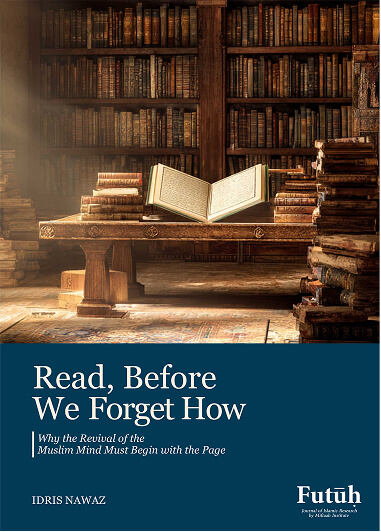
From Scroll Culture to Sacred Knowledge

Read, Before We Forget How

Issue 1

Published:

May 5, 2026

By:

Shaykh Idris Nawaz

DOwnload

Read, Before We Forget How

INTRODUCTION

There are famines that empty the stomach, and famines that empty the mind and soul. Our age suffers from the latter. We live in a time of content saturation – a world which contains an abundance of information but retains a scarcity in understanding. Words flash before the eyes in torrents, but few settle into the mind and soul. We scroll instinctively and endlessly, react immediately, and forget almost everything. The habits by which a human being turns information into knowledge, and knowledge into judgment – the slow, patient, demanding habits of sustained reading – have grown progressively weaker.

The decline is not merely technological; it is moral, intellectual, and civilizational. A society begins to lose its way when it no longer lingers over what it consumes long enough for information to deepen its thought and shape its worldview. For what a people consume does not remain outside them; it settles into the mind, forms their judgments, and gradually becomes the lens through which they understand themselves, others, and the world around them. From that lens emerges their way of thinking, their moral instincts, their social behavior, and the manner in which they engage life both individually and collectively.

Mortimer Adler and Charles Van Doren, in their seminal work on the art of reading, identified this condition with striking precision decades before the age of social media. They observed that the environment of modern media is designed to make thinking seem unnecessary, presenting viewers and readers with a whole complex of elements – from clever rhetoric to carefully selected data and statistics – intended to make it easy to form an opinion with minimum effort. The result, they argued, is that the reader “inserts a packaged opinion into his mind, somewhat like inserting a cassette into a cassette player. He then pushes a button and ‘plays back’ the opinion whenever it seems appropriate to do so. He has performed acceptably without having had to think.”

Adler wrote those words before the algorithm, before the normalization of endless scrolling, before the reduction of complex concepts into ninety-second summaries, consumed between obscene content and advertisements. The condition he described was serious then, and it has since become a causal factor of civilizational decline.

The Muslim condition stands unexempt from this decline, and in some respects represents its gravest weakness. Here is an Ummah whose founding revelation began with a command to read – a community that, at the height of its intellectual prowess, built libraries of half a million volumes, cultivated scholars who repeated the same book five hundred times in search of new understanding, and produced a culture of the written word so pervasive that the historian Will Durant would observe:

“The passion for acquiring books in no other land in the world... reached what it reached in the lands of Islam in the eighth, ninth, tenth and eleventh centuries.”

That same community today inhabits a radically diminished reading culture. We have inherited the slogans and language of a tradition of knowledge without inheriting its demands. We bear pride to a legacy of intellectualism but resist its most basic standards. We celebrate a tradition of great texts that filled volumes yet live on fragments. We speak of revival and progress, while bypassing one of its first doors: the page.

The present article is an attempt at that identification – and, beyond identification, at understanding what reading is, why Islam placed it at the center of human life, how the scholars of the past embodied it, and what a recovery of the reading habit might mean for a Muslim community that remains committed to developing a strong Islamic worldview and fostering intellectual progress. It is also an inauguration: the first article of this journal is, deliberately, about reading, because no conversation about the Islamic tradition can begin anywhere else.

WHAT IT REALLY IS: READING FROM A WESTERN PERSPECTIVE

Before any argument about the importance of reading, a prior question demands an answer: what kind of reading are we actually discussing? The modern crisis of reading is not simply the disappearance of literacy in its abstract sense. Rather, it is the erosion of serious reading as an intellectual discipline.

Adler and Van Doren drew a distinction between reading for information and reading for understanding. Reading for information – the acquisition of facts, the following of news, the consumption of summaries – constitutes most of what passes for ‘worthwhile’ reading in our age. Although this type of reading is not without value, it is categorically different from reading for understanding, which Adler defines as the activity that occurs when “the mind passes from understanding less to understanding more.”

True reading, in this sense, is an active exertion of the mind upon material that initially exceeds the reader’s grasp and creates more perspective. By sifting through the lives of prophets and sages, the metaphysical structures of religion, the arguments of philosophers, the stories of conquests and civilizations, and the reflections of human beings across time and place, the reader learns to name what he has felt but not yet articulated, to compare his assumptions with other perspectives, to organize scattered impressions into coherent thought, and to relate isolated facts to larger meanings.

In this way, reading helps form a person’s worldview; it creates curiosity that implores reflection and thought, presents structure to experience, and gives meaning to life.

“The art of reading, in short,” Adler writes, “is the process whereby a mind, with nothing to operate on but the symbols of the readable matter, and with no help from outside, elevates itself by the power of its own operations.”

The distinction matters because a society may be saturated with information – scrolling endlessly and skimming constantly – and still be intellectually impoverished, if the habit of reading for understanding has weakened. Our generation has managed precisely this paradox: more words, less comprehension.

The importance of reading extends well beyond the formation of the individual’s identity. The 1969 International Reading Association conference, whose proceedings were published under the title Reading and Revolution, framed reading as a social force inseparable from civic life and the capacity to participate in an increasingly complex world.

Its editors described the ability to read as “the basic communications skill essential to releasing and training human potential.” Philip Rutledge’s contribution to that volume deepened this point: he concluded that “those failing to acquire skill in reading are destined to become casualties of the technological revolution.”

Writing in 1969, he was describing early computing and industrial automation. One shudders to consider what he would say of an era defined by artificial intelligence and the demand for complex information processing across virtually every sphere of work and civic life.

The dimensions of reading’s importance extend further still. A medical study published in the Archives of Ophthalmology established that functional literacy – namely, the ability not merely to read words but to understand, interpret, and act on what one has read – correlates directly with health outcomes. Patients with inadequate literacy showed a fifty-two percent increase in hospitalization risk even after factoring in age, income, insurance status, and other factors.

The study revealed a pervasive and debilitating shame among those with low literacy – a shame that causes people to avoid seeking medical care at all, mistreating the physical cost of illiteracy with a psychological one.

Reading, then, is not an ornament or accomplishment of an educated life. It is part of what allows human beings to navigate reality rationally. The principle here is clear: the page trains meaningful judgment. A community that does not read deeply will struggle not only intellectually but physically.

These findings from Western research demonstrate that serious and reflective reading is a prerequisite for the progress of human society – in the formation of identity, the exercise of social judgment, and the most basic care of one’s body and health.

For Muslims, however, the concept of reading begins somewhere else entirely, somewhere preceding all modern research, far more comprehensive in its structure and therefore demanding in its implications.

THE FIRST WORD: READING FROM AN ISLAMIC PERSPECTIVE

The Qur’ān did not begin with a creed or law. It began with a command:

Iqra’ bi-smi rabbika alladhī khalaq – “Read in the name of your Lord who created. He created man from a clot of blood. Read, and your Lord is the Most Generous. He who taught by the pen. He taught man that which he knew not.”

Among all the commands He could have issued or the principles He could have established, Allāh chose to inaugurate the final Ummah – The Ummah of the Prophet Muhammad ﷺ – with read.

He paired that command with the pen: the instrument of writing, of preservation, of the transmission of knowledge across time. Creation, lordship, reading, and the pen are joined in the first five verses revealed to the Prophet ﷺ. The civilizational framework it creates is impossible to miss.

Franz Rosenthal, whose study of the concept of knowledge in Islamic civilization remains one of most comprehensive scholarly treatments of its subject, approached this opening through philological analysis.

The root ‘I-l-m in all its derivations appears approximately 750 times in the Qur’ān. Among lexical roots expressing a specific religious or ethical concept, only the divine name Allāh and Rabb surpass it.

Justice appears sparsely; freedom is not named at all; knowledge is mentioned rather very commonly.

Rosenthal concluded that:

“The terms that were truly important to the Prophet ﷺ do indeed occur in the Qur’ān with greater frequency than all others... Every single occurrence of the root forms part of a plan to condition receptive minds to ‘knowing’ as a basic force in the new religion.”

The Qur’ān, by the weight of its own vocabulary, places knowledge at the center of what it is asking human beings to become.

Several Qur’ānic verses crystallize this centrality:

“And Allāh brought you forth from the wombs of your mothers not knowing anything, and made for you hearing, sight, and hearts, so that you may give thanks” (16:78).

Human beings begin in ignorance. They are furnished with the instruments of perception – hearing, sight, and the heart as the seat of understanding – and their ascent toward knowledge is embedded in the structure of gratitude.

Thus, not to exercise those instruments in the pursuit of understanding is, in the most literal sense, to be ungrateful for them.

The Qur’ān then asks:

“Say: Are those who know and those who do not know equal? Only those possessing intellect reflect” (39:9).

The contrast of ‘knowing’ is not merely one of novelty or as a skill. The knower and the ignorant have different relationships to reality itself.

“Allāh will raise those who believe among you and those who were given knowledge by degrees” (58:11).

Knowledge, then, is a mechanism of progress and elevation in this world and the next, not merely an intellectual skill or accomplishment.

The Qur’ān also reveals the Prophet’s ﷺ own orientation when he is instructed to pray:

“My Lord, increase me in knowledge” (20:114).

Ibn Ḥajar al-‘Asqalānī observed in Fatḥ al-Bārī that “Allāh did not command His Prophet to seek increase in anything except in knowledge.”

Taken together, these Qur’ānic verses illustrate that knowledge is the concept around which everything else organizes itself.

The Muslim community in the time of the Prophet ﷺ received these verses of knowledge not as an abstract concept but one that necessitates action.

The process for learning knowledge was twofold: through the oral tradition – by means of transmission and memory – and the written tradition – by means of reading and writing.

Among the illustrations of how seriously the latter was taken in preserving the verses is the policy the Prophet ﷺ established after the Battle of Badr.

Among the prisoners were men who possessed a skill the companions of the Prophet ﷺ lacked: literacy. The Prophet ﷺ ordered that prisoners who could not afford their ransom but can read and write may earn their freedom by teaching ten Muslim children to read and write.

The message derived from that decision is clear: literacy is important as a civilizational value and as a means of learning knowledge. A society that can read is worth more than any spoils a victory in battle can yield.

It was also a civilizational declaration about what a Muslim community has to cultivate and prioritize for progress.

BENEFICIAL READING: REPETITION AND RETURN

The reading practices of the classical scholars was distinguished by a feature that stands in contrast to the contemporary habit of consumption: the culture of return and repetition.

The scholars did not consider a book to be fully understood or exhausted after one reading.

Qāḍī ʿIyāḍ transmits from Abū Bakr al-Abharī, a leading Mālikī jurist, an account of his engagement with the texts of his tradition:

“I read Mukhtaṣar Ibn ‘Abd al-Ḥakam five hundred times, the Asadiyyah seventy-five times, and the Muwaṭṭa’ forty-five times.”

Ibn ‘Aṭiyyah’s father is reported to have read Ṣaḥīḥ al-Bukhārī seven hundred times.

Al-Rabī‘ al-Muzanī, the student of al-Shāfi‘ī who had memorized, transmitted, and taught the Risālah for five decades, is recorded as saying:

“I have been looking into this book for fifty years, and I do not believe I have ever looked into it once except that I benefited from it something I had not known before.”

These reports describe a method predicated on an essential principle: that beneficial books yield their meanings gradually, across years and decades, to readers willing to return.

Thus, rereading is the ripening of a text’s understanding.

Another exposition of the returning culture of reading was the institution of the waqf library – books that were endowed as a public trust and were accessible to all in the society.

Mosques, seminaries, hospitals, and travel lodges housed endowed collections of books in a time when the printing press was not born.

Scholars gathered books across a lifetime of searching and spending, then converted the fruits of that passion into public access, creating the understanding that the book was to be passed onward, as a civilizational heritage.

The example of al-Ḥakam al-Mustanṣir of Andalusia remains among the best illustrations of what this culture could produce at its height.

He assembled one of the greatest libraries of the medieval Islamic world.

The library held approximately half a million volumes.

More remarkable still: al-Ḥakam did not merely collect. He read, annotated, and sponsored translations.

He maintained connections with booksellers across the world and paid generously for first copies of important new works.

When Abū al-Faraj al-Iṣfahānī completed his monumental Kitāb al-Aghānī – an encyclopedia of Arabic poetry and music – al-Ḥakam sent a thousand dinars so that the first copy would reach Cordoba before it appeared anywhere else in the world.

This creates the understanding that reading, within the Islamic tradition, serves as the means through which a civilization sustains its access to the full spectrum of human knowledge.

READING AS A MEANS OF PROGRESS: THE ISLAMIC PURPOSE OF THE PAGE

The grandeur of this tradition makes all the more urgent a question: to what end? What is the purpose of reading?

For the great Muslim scholars of our heritage, the love of books was not separable from the purpose they were meant to serve.

Abū ‘Abdul Raḥmān al-Sulamī, one of the Prophet’s ﷺ companions, described the habit of reading the Qur’ān amongst the companions:

“When one of them learned ten verses, he would not move beyond them until he knew their meanings and acted upon them.”

This illustrates the understanding that reading was a curriculum of transformation.

The Prophet ﷺ made this accountability explicit:

“The feet of a servant will not move on the Day of Resurrection until he is asked about his life – how he spent it; about his knowledge – what he did with it; about his wealth – from where he earned it and how he spent it; and about his body – how he wore it out.”

The second question, notably, is not about how much knowledge through reading that an individual has accumulated. It is about what they did with what they had.

This illustrates the understanding that it is not the time spent in reading nor the size of the library, but the depth of the transformation it produced that is considered in Islam.

Joseph Lumbard’s analysis of Islamic epistemology clarifies what lies behind this understanding.

The pursuit of reading and acquiring knowledge in Islam has always been inseparable from the religious and identity formation of the individual who seeks it: the cultivation of an individual capable of distinguishing truth from falsehood, the real from the illusory.

What Taha Abderrahmane identified as the deepest crisis of the contemporary Muslim mind – an “intellectual perplexity” produced by being “inundated by a multiplicity of concepts fashioned by other societies,” unable to “fully grasp them” or “effectively reject them” – is precisely the crisis of a community that has stopped forming itself through serious engagement with its own tradition and with the best of human knowledge across all fields.

The revival runs, necessarily, through the page.

WHAT WE HAVE BECOME AND WHAT WE MUST BECOME

The difference between that civilizational culture of reading and literacy and our present condition is not difficult to diagnose, though it is painful to contemplate.

Wael Hallaq’s account of what colonialism did to the Islamic intellectual tradition illustrates this diagnosis:

“The death of education, of the traditional scholarly circle, and of the madrasa signaled the effective extinction of an entire sociology of knowledge, of a hermeneutic that governed the production of a particular kind of knowledge. The destruction of this system was so colossal that one is compelled to describe it as a structural genocide.”

Here, the destruction of the Islamic civilization may have been external, but it found root causes internally: the community that stopped reading stopped thinking, and the community that stopped thinking stopped producing.

And the community that stopped producing found itself, as Taha Abderrahmane observed,

“wandering through the labyrinths of other people’s thoughts, unable to find its way home.”

The contemporary symptoms of this condition are familiar enough: reading has been replaced, for the most part, by scrolling.

The book – which Ibn al-Mubārak understood as companionship with the Prophet ﷺ and his companions – has been displaced by the algorithmic feed, which offers the companionship of what is trending.

The scholars of the past read the same text hundreds of times, returning to it the way a lover returns to a beloved, always finding something new.

The contemporary Muslim scrolls past a thousand opinions in an hour and retains perhaps three, and those three will be gone by the evening.

This stark contrast reflects two entirely different understandings of what the human mind is for and what consumption of information and content is meant to do.

The solution does not lie in nostalgia.

The tradition that produced al-Jāḥiẓ and Ibn al-Qayyim cannot be reconstructed by lamenting its collapse or speaking of it as a ‘golden era’.

What can be reconstructed—rather, what must be reconstructed—are the demands and the ethos of such a tradition: its intellectual environment, its disciplines, and the habit of sitting with a book long enough for it to leave an impression.

And the love – for Ibn al-Jawzī did not read twenty thousand volumes because it was his duty, and al-Jāḥiẓ did not spend his nights in a bookseller’s shop because scholars were expected to.

They read because they had tasted what reading offers and found it sweeter than anything else the world had to offer.

WHY THIS JOURNAL BEGINS HERE

A journal that aspires to serve the Muslim community must begin where the tradition itself began: with iqra’.

An inaugural article on reading is an act of clarification about what kind of community this journal imagines and what kind of readers it hopes to address.

Before there can be religiosity, spirituality, and scholarship, there must be reading.

Before there can be a renewal of the Ummah’s progress, there must be a renewal of the page.

This means something concrete.

It means homes in which books are visible and used, not merely arranged for display.

It means circles in which re-reading is honored, in which returning to a difficult text for the third or fifth or tenth time is understood as the mark of a serious mind, rather than an admission of failure.

It means a renewal of the habit of understanding, discussing, and practicing upon.

And it means, above all, a renewal of the conviction that reading is part of how Muslim life remains intellectually alive – not something left to the scholars.

The modern literature on reading confirms from the outside what the Islamic tradition established already: beneficial reading, that which is understood and practiced, is not optional for a community that wishes to progress and address the issues that affect modern society.

The Islamic perspective of reading extends it further yet: that reading, when oriented toward Islamic knowledge and its practice in life, becomes part of worship and gaining closeness to the Divine.

The first word that opened this Ummah’s revelation was iqra’.

If iqra’ gave Muslim civilization its distinctive identity, then its renewal must begin, once again, with iqra’.

We must read: not hurriedly, not occasionally, but for formation.

We must read until books regain the companionship that Ibn al-Mubārak found in them.

We must read until knowledge regains the urgency that drove al-Jāḥiẓ into booksellers’ shops through the night.

We must read until the Muslim mind remembers again how to engage with the page – and until engaging with the page becomes, once again, the way by which a community of understanding is built… one reader at a time.

https://heyzine.com/flip-book/b7f24b3835.html

Build something that outlives you. Invest in knowledge that never stops.

Donate today and be part of the legacy.

donate Now